Introduction
There are reasonable differences between digital and traditional marketing practices. Analysing the differences it is important to interpret which type of marketing will suit the requirement of individual marketer. Digital marketing is constantly evolving. However, the trend of basic popularity in traditional marketing compels marketers to choose this option of marketing. This research will delineate the advantage and disadvantage of traditional and digital marketing in multiple contexts (Kayumovich and Annamuradovna, 2020). In congruence with the relevance of different business and the scope of marketing in individual business domain, is research will create a detailed discussion of multiple approaches of digital and traditional marketing demonstrating their respective importance.
Digital marketing is the use of digital channels like websites or social media as marketing tools for establishing communication with external stakeholder groups. Any social media user should have some across advertisements popping up in the mainstream social media profile of the individual. This is a very basic example of digital marketing. On the contrary, traditional marketing involves the use of traditional channels like printed media or billboard or electronic media. Use of electronic media is versatile as it is a sometimes counted among digital marketing medium and sometimes in traditional marketing medium. On a general note, before the introduction of the digital marketing processes, use of electronic media like television was a still counted among the traditional means of marketing. Speaking of traditional marketing assignment writer think about Don draper in mad men who was a brainstorming about TV commercial ideas and a copy for the Coca-Cola company (FIAMMENGHI, 2019). Until the development of internet across the world vehemently since 1990, use of traditional marketing was the only kind of marketing available for organisations.
Analyzing The Difference Between Traditional And Digital Marketing
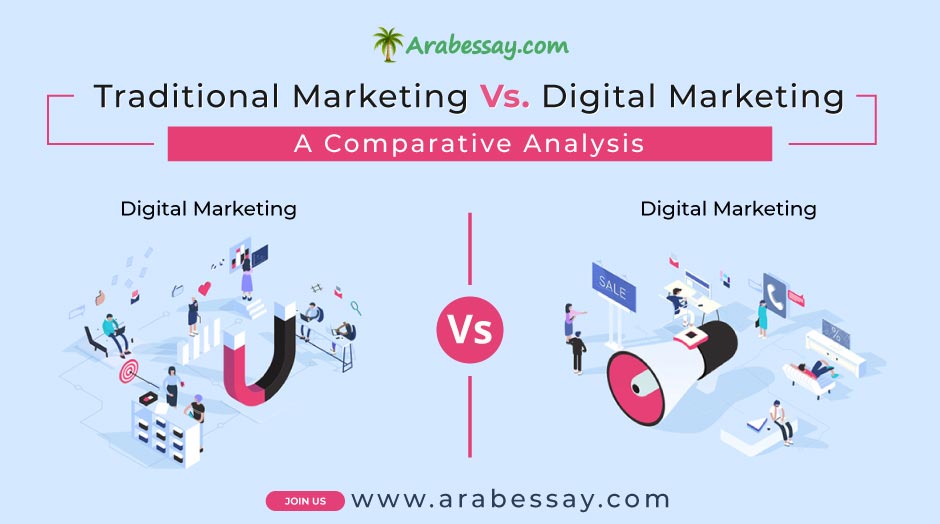
The primary difference between traditional marketing and digital marketing is the use of medium through which the marketing message is conveyed to the audience. On one hand, traditional marketing uses traditional form of media like print media which involves magazine and newspaper. In contrast, digital marketing is based on the use of digital media like social media or paid and unpaid websites.
Traditional marketing should not be considered old-fashioned (Bala and Verma, 2018). In spite of the rapid growth of digital marketing in almost all industry, traditional marketing still has the primary role to play in influencing lives of people, even in the face of ever-growing requirements to step out in the digital world.
Significant impact of impactful television commercial and tactile nature of the rolling stone magazine are as important and significance today as it has been twenty years ago, because of the lasting impact it created on the mind of people. On a subconscious level, we are still reminiscent about the impact that it created. We are still attached with the brand on an emotional level implying that the brand loyalty of the company is a still on a high note.
In the same way the aspects of digital marketing equally important. On some cases they are more important than traditional marketing. Digital marketing uses the specific everyday touch points of internet users for reaching customers. An example can be provided. An individual might be searching for best holiday ideas for the upcoming weekend getaway or vacation. There are high level of chances that very soon pop-up advertisement of Sky scanner will show up on the screen (Roncevic, Lukcic and Spoljaric, 2019). Using internet for multiple casual and work purpose is every day, is a a must to do in everybody’s lives. Plagiarism free assignment help suggested Digital marketing uses this window as opportunity bye cleverly integrating marketing communication messages through digital channels to reach the customer just when they are in a need for some similar products.
Selection Of Reasonable Marketing Methods
Most researchers argue that the crux to successful marketing is finding the correct balance between traditional marketing as well as digital marketing. In the year 2021, digital marketing is on the forego. None of the organisations can yet disregard the significance and importance of traditional marketing. Both create a very strong impact in the mind of the audience when used together. The example of Guinness can be taken in this regard. Their television commercials have become very famous because of the uniqueness and highly significant cinematography. After twenty years of development the classic 1999 campaign of Guinness is still considered to be one of the most famous television commercials of all times (Kaur, 2017). Even with the legendary status the organisation still had to incorporate relevance in their marketing process and imbibe digital marketing strategies so that did not miss out in a significant marketing scope and opportunity of appearing to any significant target customer segment. GUINNESS stepped out into the domain of digital marketing in order to create appeal towards brother as well as younger audience therefore expanding the target market. In order to increase the scope of digital marketing, Guinness used video content significantly and disbursed the same over Facebook and Instagram. Rather than simply accomplishing marketing goals like refurbishing television commercials the organisation developed the campaigns as the first social video by composing their shots specially with Instagram and Facebook features in mind. The videos were very critically targeted to the audiences of our Facebook and Instagram separately and respectively (Riedler, 2020). As an outcome of the organisation was able to create a visually stunning and highly influential social media campaign exhibit in Compton cowboys who care for their horses in California. Major team of the researchers called their campaign perfectly trendy and highly shareable feed for Instagram.
Advantage And Disadvantage Of Traditional Marketing
The current increase of prominence of social media has led to undermining the importance of traditional marketing methods. However a large number of researchers counterfeit this fact. Traditional marketing still has a critical role to play in everyday life of consumers. In case if companies have the budget to sponsor the campaigns over magazine and television then the campaigns can be very significant. Traditional marketing include outdoor marketing like set up of billboards, posters, vehicle wraps and so on other than that the popular traditional marketing channels include broadcasting of television and radio followed by print release over magazine and newspapers (Minculete and Olar, 2018). Telemarketing with help of phone and text message along with window display and sign is also considered to be critical option of traditional marketing. To know more, get free term paper help from ArabEssay professional team today
Advantages
Traditional marketing is very impactful. It is also very easy to understand. Visually appealing billboards or very significant television commercials are normal aspect of everyday lives of people. People find it easy to digest them and often find them entertaining (FIAMMENGHI, 2019). This have an impact on their subconscious mind which enables them to purchase the concerned products.
Printed Marketing Materials Have Permanent Impact
If there is an advertisement in any of the issues of New York times, then it will be published and circulated until the magazine is recycled.
Content Of Traditional Marketing Is More Memorable
Seeing something in the real life in comparison to that on the phone is likely to be remembered with more impact. Anticipation of the super bowl advertisements or some impressive window display a likely to stay in the mind more in comparison to any Instagram advertisement which are casually scrolled away by people.
Disadvantages
Difficulty In Measuring Campaign
It is very difficult to measure the campaigns over traditional media. There are specific way of measuring traditional campaign like brand cracker however such tool are not highly influential or intelligent like the tools available for measuring the impact of digital marketing (Sherman, 2019).
Often Expensive
If a start-up organisation tries to conduct traditional marketing then it is very viable that it will not have the necessary fund for A4 pages spread advertisement in vogue magazine. The expense of various kinds of traditional marketing is considered to be a critical setback.
Absence Of Direct Interaction With Customers
Unlike the social media and other form of digital marketing, traditional marketing keeps the marketer in the dark regarding the reaction of audience. It makes the aspect of anticipating the outcome of marketing effort difficult in case of traditional marketing.
Advantage And Disadvantage Of Digital Marketing
There is no doubt that traditional marketing has very significant impact. However in contrast we should not forget that we are living in the internet age and currently digital marketing is having very significant and height gauge impact if not greater impact in consideration to traditional marketing. Currently about 60% of global population are about 6 hours and 40 minutes online on an average every day. It is projected that by the end of the year 2021 about the 73% of e-commerce sales will be based on orders placed from digital devices. Therefore it is height and that organisation should you spend significant time and opportunity for clever digital marketing activities (Bailey, 2020). The most important aspect of digital marketing activities is a social media marketing over Facebook or Instagram. As per the instant assignment help professional view, There are other social media channels as well. Website marketing followed by paid and unpaid content marketing constitutes two very important elements of digital marketing. Getting also takes into account the elements like affiliate marketing or inbound marketing. In order to impact pay per click or search engine marketing, it is also used as a part of digital marketing.
Advantages
Scope For Engagement
Better scope for engagement is one of the greatest benefits of digital marketing. Use of channels like social media enables physical perception of what the audience things about the brand and the marketing campaigns. The marketers are able to understand that give their content is being repeatedly shared and liked and ushered with significant amount of positive comment, then the campaigns would become fruitful in the long run (Key, 2017).
Easy In Measuring The Campaign Outcome
On the flip side to traditional mode of marketing, the elements of digital marketing tracking is exceptionally into the depth. It makes the learning extremely clear for the upcoming round of marketing initiatives.
Helps In Achieving Clever Targeting
Digital marketing creates a hands-on approach to understand customer preferences. For evidence if an organisation has the tools of specifically targeting and understanding demands of a specific demographic criteria of unit customers well they can easily create perfectly tailor-made content and even perfectly customised products for fitting the requirement of the customers.
Disadvantages
Digital Advertisements Are Annoying
It is considered that digital advertisements can be annoying. Sometimes people can simply scroll Facebook home page for perceiving activity of friends. However they will come across a sponsored advertisement for something which the individual has been searching over an e-commerce website or other digital media the last night or day before (Sharma, Sharma and Chaudhary, 2020). It is undoubtedly a disliked activity however in spite of being clever targeting.
Lack Of Permanence
The efforts in digital marketing like use of Google advertisement or promotional email or social media advertisements can be resulting in a fleeting outcome. They are not tangible and this kind of advertisements can be easily ignored. In case if target audience keep on scrolling or clicking on the next page, the advertisement will then be gone from the screen.
Constant Evolution
In order to achieve the major positive impact from digital marketing effort it is important for organisations to acquire greater learning. Individual social media channel needs their own specialist for activities ranging from search engine marketing social media (Roncevic, Lukcic and Spoljaric, 2019). Every channel require professionals to get the best outcome against the content promoted. However grassroots social media marketing campaigns are also a great start for entry level companies.
Competition For Better ROI
Traditional marketing might have evolved in last twenty or thirty odd years. However, all fundamental aspects of traditional marketing remains the same. The marketing techniques used by organisations in the current day depend significantly on the very relevant 4 p’s of marketing. These are product, place, social enterprise. All successful business understands the significance of developing proper sales funnel. Leveraging 4ps of marketing here’s a business to achieve the prospect and customers through any individual sales funnel and perceive the favorable outcomes.
Product: Effective marketing initiatives with proper understanding of the capabilities and limitations of owner product. Any organisation has a good idea regarding whether their product will create high demand in the target market or it will always stay intangible.
Price: Overall cost associated with the product depend on the level of understanding regarding the product. Price always become the determining factor when the elements like supply or demand or profit margin comes into context of discussion (Yang and Jun, 2002).
Promotion: It refers to the strategy for getting the publicity about the product into the market. And helping in promotion of the product and acquiring better visibility comes under the aspect of promotion. Therefore advertisement posted on the billboard is a promotion and setting up Facebook advertisement is also a promotion.
Place: traditional marketing is highly dependent on Getting product in front of target audience at the right time and at the right place. It also imply putting up the right price. In marketing domain, placement has a significant role. Since the product is placed in an ideal location, there is significant chance of converting prospects to customers.
Apparently digital marketing can look different in comparison to traditional marketing in large number of ways. However, it all comes to the differences in the fourth element of the 4 p’s of marketing model, promotion. Digital marketing has great impact as it takes into account the elements in all four p’s of marketing. In fact there is uniqueness in the way digital marketing approaches towards fulfillment of the elements discussed under all four p’s of marketing (Ibrahim, Aljarah and Ababneh, 2020). Researchers state that the way in which digital marketing accomplishes the elements of 4 p’s of marketing is sometimes better than traditional marketing. Get to know more about 4 ps of marketing from essay writing help team of ArabEssay
Downsides Of Traditional Marketing
It is undoubted that traditional marketing still has a very crucial point of impact. It is the biggest platform for immediately taking a product among the largest possible target market. However, researchers nowadays state that with the advent of technology it is possible for marketers to communicate their business with audience in many new opportunities. Investigation of the loopholes of traditional marketing is important. It is now not the only viable opportunity of marketing.
Lack Of Interaction
One of the most obvious and immediate limitation of traditional marketing is that there is seldom any scope of interaction between customers and the medium of marketing used by the marketer. Traditional marketing is undoubtedly the biggest platform for surfacing and broadcasting information towards the target audience (Key, 2017). However the brand building exercise is practiced with the hope of attracting attention of the appropriate people and the wish of converting them into potential customers. It is mostly possible when the medium of marketing used by the market and will have the scope of two-way communication.
Lack Of Control Over Timing
Traditional marketing depends on the promotional methods which has been executed however now cannot be updated. It can be a static release over newspaper or other commercial platform like television. In order to revise the existing information it is important to bring down the previously published information and replace it with a new advertisement. It is not possible to bring about any change or replacement in the old one itself. On an immediate basis it has hardly any impact. In the long run it can however create significant impact. An instance can be in this regard. There can be an organisation which is the running a magazine advertisement for promotion of the latest widget (Riedler, 2020). There can be a major update to the widget which can have significant impact in customer purchase if the same is promoted. However the use of traditional marketing method will make it impossible for the organisation to change the current advertisement which has been on air. In order to do so there will be a huge dent in the marketing budget. It imply that by doing so the organisation will we already incurring great amount of expense.
Higher Cost
Recurring costs in doing traditional marketing can be a significant investment in which you might or might not provide substantial return. The advertisement in local newspaper will be successful and effective if only the target audience see the advertisement on the day when it is published. However there is no algorithm for probability with substantiate that are the target audience will definitely see the advertisement in the newspaper on that specific day. Therefore in order to fill in the gap it is important to put up the advertisement repeatedly which is definitely reason why higher costs are associated with traditional marketing. There is no other alternative also (Sherman, 2019). This is because any organisation would like to ensure that the marketing content developed by them, reaches the maximum possible target audience and creates sales impact. Development and distribution of posters and flyers are considered to be one of the most popular form of traditional marketing. However it is a one-time exposure and again there is a high level of chance that the target audience might not have collected the poster on that specific day. In comparison if the content was published over a website then it would have brought in large number of targeted visitors. Else to know more buy assignment online from ArabEssay to get much detailed information.
In case if it would have fallen into hands of wrong target population they would have employed the word-of-mouth publicity to let the target audience know about the advertisement. In this case there is a little controversy. A set of researchers argue that in case of the print campaign over a newspaper or a poster, the same can also be distributed. For evidence, a new elevation model is published by a company. In order to promote the new product the company creates the posters and distributes them on road. Considering the above logic the poster falls into the hands of an individual who has recently purchased a television. It is evident that he is certainly not among the target customers second. For that purpose, it can also fall into the hands of a person who is not loyal to the specific television brand. He might not have the habit of watching television and rather prefer to buy a costly mobile phone or tablet. In that case even if we cannot do word of mouth publicity he can simply pass the newspaper page or the posted to a person whom he might know to be in requirement of the same equipment or product. Therefore the question arises how it is different from digital marketing and house the scope of word-of-mouth publicity in digital marketing is better. Digital marketing offers a scope of sharing content over a very large audience base (Bala and Verma, 2018). In this case a leaflet or a poster might be shared to maximum two or three people. However that also cannot be possible at the same time. Majority of brands provide offers for limited time period. The means of traditional marketing, by the time the leaflet reaches the hands of targeted customer who would be willing to purchase the product, the company might have pulled up the product line or On the offer. In contrast in case of digital marketing people have the ability of sharing specific content with all their social media friend and acquaintances (Kayumovich and Annamuradovna, 2020). In fact, people outside their friend list can also have a look into the content. This is how if the content is shared simply three to four times, it will be able to grab the attention of a larger target audience in comparison to traditional marketing.
Conclusion
In conclusion, it can be articulated that digital and traditional marketing have their own place of importance. However it can also be summarised that are considering the needs like rapid promotion and faster word of mouth publicity at minimal and negligible cost, there is perhaps no alternative to digital marketing. Therefore it can also be concluded that small businesses will be benefited by using digital marketing in comparison to traditional marketing. Organisations should attempt to digital marketing if they are not finding significant growth through traditional marketing. The research study has clearly articulated the loopholes of using traditional marketing. There is little risk involved in digital marketing however with great return of interest. It ultimately depends on the business and its promotional needs; digital and traditional marketing processes will be used for maximum possible profit.
Reference List
Bailey, . 2020. Digital marketing vs. traditional marketing: what’s the difference? – 99designs (2020). Available at: https://99designs.com/blog/marketing-advertising/digital-marketing-vs-traditional-marketing/ (Accessed: 19 February 2021).
Bala, M. and Verma, D., 2018. A critical review of digital marketing. M. Bala, D. Verma (2018). A Critical Review of Digital Marketing. International Journal of Management, IT & Engineering, 8(10), pp.321-339.
FIAMMENGHI, C., 2019. Communication in internationalization strategies, from traditional to digital marketing: the case of Coca-Cola Italia.
Ibrahim, B., Aljarah, A. and Ababneh, B., 2020. Do social media marketing activities enhance consumer perception of brands? A meta-analytic examination. Journal of Promotion Management, 26(4), pp.544-568.
Kaur, G., 2017. The importance of digital marketing in the tourism industry. International Journal of Research-Granthaalayah, 5(6), pp.72-77.
Kayumovich, K.O. and Annamuradovna, F.S., 2020. The main convenience of internet marketing from traditional marketing. Academy, (1 (52)).
Key, T.M., 2017. Domains of digital marketing channels in the sharing economy. Journal of Marketing Channels, 24(1-2), pp.27-38.
Minculete, G. and Olar, P., 2018, June. Approaches to the modern concept of digital marketing. In International conference Knowledge-based organization (Vol. 24, No. 2, pp. 63-69). Sciendo.
Riedler, L., 2020. Traditional and digital marketing towards Generation Z.
Roncevic, A., Lukcic, T. and Spoljaric, P., 2019. Impact of traditional and digital marketing on consumer perception. Economic and Social Development: Book of Proceedings, pp.330-340.
Roncevic, A., Lukcic, T. and Spoljaric, P., 2019. Impact of traditional and digital marketing on consumer perception. Economic and Social Development: Book of Proceedings, pp.330-340.
Sharma, A., Sharma, S. and Chaudhary, M., 2020. Are small travel agencies ready for digital marketing? Views of travel agency managers. Tourism Management, 79, p.104078.
Sherman, S. 2019. Digital Marketing vs Traditional Marketing: Which Produces Greater ROI? (2019). Available at: https://www.lyfemarketing.com/blog/digital-marketing-vs-traditional-marketing/ (Accessed: 19 February 2021).
Yang, Z. and Jun, M., 2002. Consumer perception of e-service quality: from internet purchaser and non-purchaser perspectives. Journal of Business strategies, 19(1), p.19.